Thursday, January 20, 2011

"Er...this isn't what it looks like."

Film: Cyrus
Rating: 4 1/2 out of 5

Brothers Jay and Mark Duplass have heretofore been leading filmmakers in the independent "mumblecore" movement. Though some of the mumblecore ideals are not present in their newest film, one thing they do retain is the low-budget aspect, and the camerawork here is very interesting. It seems to use a lot of zoomed-in shots from far-away vantage points, as if to give an objectivity to the film, to remind us that we don't have to be a part of the action, we can simply be outside observers. In spite of this, one of the movie's best achievements is that the tone of the film always marvelously reflects the emotions of the hero.

The subject of their new film is John (John C. Reilly), seven years divorced, alone, and still unadjusted to his life. John is confident, he knows he isn't a depressing or unpleasant guy, except when he's actually around women. He maintains a friendly relationship with his ex-wife Jamie (Catherine Keener), but is pushed further into lonesomeness when he learns that she is about to be remarried. Casting John C. Reilly was a great stroke of luck or of genius for the Duplasses. Reilly is a perfect fit; experienced in many genres including the offbeat comedy here, and one of the most likeable actors around. Hardly any effort is necessary to get us on his side, and even less to keep us there.

In a sincere attempt to help John, Jamie drags him along to a party, only to watch him get drunk on Red Bull and vodka and embarrass himself in front of all of the women there. One of them, however, sees the geniality and good-natured humor in him, and he ends up taking home the mercurial, alluring Molly (Marisa Tomei). As their relationship develops, John starts to think he's found someone special. Until he meets her charming but overly dependent son Cyrus (Jonah Hill). Cyrus is 21, still living with Molly, and as John learns, not willing to share her. His father long gone, his mother hasn't even had a real boyfriend since he was born. As Cyrus continues to meddle in their relationship, John has to figure out how to keep his romance with Molly intact.

There is a delicate pile of emotions here to deal with, and the Duplasses handle them sensibly. There are a number of precarious lines that could be crossed (namely, the incestuous one), but they avoid most of this dark material in favor of tenderness and compassion. But still some dark material. Both the humorous and the serious elements are treated with realism, but when necessary with a certain buoyancy that may not have been achieved with other actors. Jonah Hill plays Cyrus as kind and fragile, but with sinister undertones that creat the mildly unnerving yet amusing tension between him and John. Marisa Tomei is spectacular as the emotional Molly, who has been too tired and too single for too long but is dedicated to nurturing Cyrus. She might be a little naive, at least not able to see that her relationship with Cyrus is unusual and unhealthy, but she means only the best. She wants everyone to get along, even if she doesn't know how to make it happen.

Cyrus has a fairly broad premise, and at any moment could be taken in a wildly different direction. But the filmmakers keep a very watchable indie consistency, and create a realistic comedy-drama that, from the first moment, is about social and personal awkwardness. Without ever mocking its characters, it shows us that the situations we dread being in can be both funny and touching from an outside perspective.

Wednesday, January 19, 2011

The Woody Allen template, insight not included

Film: Stardust Memories
Rating: 3 out of 5

By far his most audience-splitting release, Woody Allen's Stardust Memories is certainly one of his more puzzling. Allen plays Sandy Bates, a renowned director who has lost his comedic inspiration and sees only the suffering in the world. He is constantly harassed by legions of adoring fans, often commenting that they prefer his "early, funny" films. The main storyline focuses on Sandy's conflicting attractions to two very dissimilar women: the intellectual Daisy (Jessica Harper), and the maternal, caring Isobel (Marie-Christine Barrault). At the same time, he is beset by memories of his ex, the vivacious but demanding Dorrie (Charlotte Rampling).

It sounds, at least partially, about Allen's own life, doesn't it? True, it is very much inspired by Federico Fellini's autobiographical 8 1/2, but Allen has vehemently denied that Stardust Memories is autobiographical as well. It turns out to be a deciding factor in the film's quality. The comedy here is human and real, but not in a way that makes a statement about humanity. When Sandy is approached by obsessive fans, we don't know whether to laugh or cry for him, so we do neither. If we knew that it was supposed to be Allen, that he was showing us his own struggles and his own artistic crises, we would happily do both. We aren't given a reason to care about Sandy, whose situation could be entirely fabricated by Allen and completely unrealistic. Scenes are disconnected from each other and surreal in a way that could be perfectly explained as fleeting memories and projections of a wild imagination, but the idea isn't made believable. The film is such an intense and personal character study that to be told it isn't real makes us feel lied to.

Honestly, Stardust Memories is a more or less well-made film. A bit messy perhaps, but there are even moments that reach a sort of self-sufficient beauty. It is well-directed, well-acted, and to some extent well-written, but ultimately empty. It seems to be a technical exercise for Allen more than anything. Thematically, a mere set of laps compared to the marathon-effort vision of some of his other productions, not to mention his inspirations.

Tuesday, January 18, 2011

"A tremendous amount of wheat."

Film: Love and Death
Rating: 5 out of 5

A certain percentage of Woody Allen's career is based on the idea of taking the same exaggerated, neurotic version of himself, placing him in different situations, and seeing what happens naturally. Sometimes it works out, and sometimes it doesn't. With his beautifully funny 1975 film Love and Death, it works better than ever.

Allen's screen persona is timid, frenetic, ultimately sweet, but naive in a way that only the wittiest person could write. There aren't many changes in his character from film to film because that would ruin the formula. Before this, he was everything from a bank robber to a robot. Have him in mind? Now imagine him in War and Peace.

Allen's sixth film is a lot like a Monty Python performance of a Dostoyevsky rewrite of The Luck of Barry Lyndon. He plays Boris Grushenko (not even attempting an accent, of course), a Russian pacifist/coward during the Napoleonic Era. When his vain cousin Sonja (Diane Keaton, another strong performance in the time between the Godfathers and Annie Hall), whom he loves, becomes engaged to a herring merchant, he joins the army. Despite numerous training mishaps, he is sent to fight the French, and inadvertently becomes a hero when he is fired out of a cannon is which he was hiding. He returns home and weds the reluctant, recently widowed Sonja, and they begin a marriage filled with philosophical debates and espionage.

Being his last film prior to Annie Hall, Love and Death is seen as a transition from Allen's earlier hectic comedies to his more serious, artistic ones. It strikes a middle ground between the styles, making it one of his broadest and best. The opening lines are rather exemplary of the film's overall tone: "How I got into this predicament, I'll never know. Absolutely incredible. To be executed for a crime I never committed. Of course, isn't all mankind in the same boat? Isn't all mankind ultimately executed for a crime it never committed? The difference is that all men go eventually, but I go six o'clock tomorrow morning. I was supposed to go at five o'clock, but I have a smart lawyer. Got leniency."

There's something magic in Woody Allen's brain that can take any setup and wade through all of the possible responses to find the absolute most clever thing to say. Before moving into his more sophisticated works, he makes sure that not one scene here is deprived of that talent, but he gives a structure to the plot that his previous films lacked. A masterful parody of 19th-century Russian epics, Love and Death becomes an indisputable triumph by juxtaposing pure Woody Allen silliness and deliberate anachronistic absurdities with philosophical satire and moments of Bergman-inspired artistry. Packed with familial relationship jokes, circular debates, bartering with the dead, fourth wall breaking, and a shot of Woody as a battlefield cheerleader, it is a rare masterpiece of comical art.

Mark Twain was called the great American humorist of his time. In the '70s and '80s, some might say it was Woody Allen.

Monday, January 17, 2011

It's like Wall Street 2, if they hadn't made Wall Street 2

Film: Solitary Man
Rating: 4 1/2 out of 5

Michael Douglas plays an intellectual miscreant better than just about anyone else. In this sharp and effective comedy-drama he takes on the role of Ben Kalmen, a once successful car dealer whose primary interest is doing things that make him feel better than anyone else. At this point in his life, that includes reliving his glory days, swindling customers, and proving his superiority of wit whenever possible. At about 60 years old, presumably trying to avoid or ignore death, Ben's life has gone downhill due to his own misbehavior. He cheats on his wife (Susan Sarandon) until she leaves him, he runs his dealership into the ground, he misses his grandson's birthday. He doesn't do these things to be mean, he just gets caught up in how much he likes himself.

We meet Ben at a point in his life where he is using his current girlfriend Jordan (Mary-Louise Parker) to gain the support of her father and close an important business deal. He meets his match in Jordan's daughter Allyson (Imogen Poots) when he escorts her to her college interview at his alma mater. In some of the most well-written scenes in recent years, the two go head-to-head with their wits on more than one occasion, and Allyson beats Ben at his own game. Everything gets worse from there. He finds himself running out the patience of his daughter (Jenna Fischer), getting beat up by mobsters, and imparting wisdom on a geeky college student (Jesse Eisenberg) only to betray him.

It's true, the story of old-guy-fears-death-causes-trouble-learns-lesson has been used before, but Douglas and writer/co-director Brian Koppelman bring an original, charismatic spark to the film. The dialogue here is sharp, logical and entertaining, building smart and realistic characters. In a time when most comedies make no effort to have moments that are serious or clever, Solitary Man has many that are both. Whenever Ben delivers some insight or explains his philosophies, we feel the same way as his audience does: that he really knows what he's talking about, or in some cases that he really doesn't. Douglas makes Ben charming in his cynical wisdom, wily and experienced in his dishonesty, and openly solipsistic in his shallow rants. Danny DeVito snags an important supporting role as Ben's old college buddy Jimmy, who now owns a diner on the campus. Jimmy is the complete opposite of Ben; humble, inviting, caring. The soul of Solitary Man lies in Ben's attempts to understand this way of life, one that he may have approached in the past but now lives in stark contrast to.

Sunday, January 16, 2011

The preposterous couple

Film: The Extra Man
Rating: 2 1/2 out of 5

"So, there we are. Where are we?" So goes one of the favorite sayings of Mr. H. Harrison. It seems to be less of a line than a musing on the script.

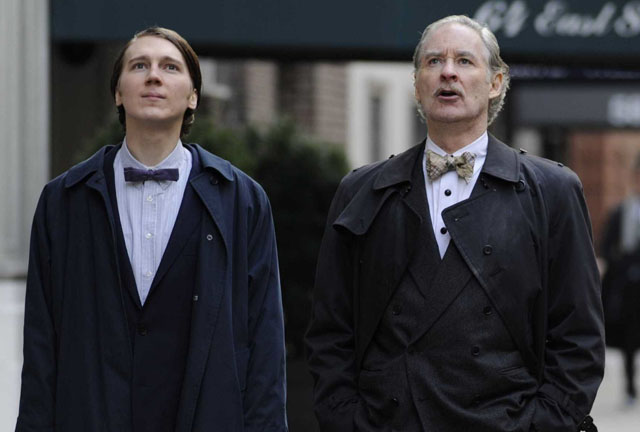
In The Extra Man, Paul Dano stars as Louis Ives, an English professor in the 1990s who feels like he belongs in the 1920s. The only problem is, he can't decide if he wants to be the Great Gatsby or Betty Boop. After being fired for cross-dressing, the troubled young man packs up and moves to Manhattan, where he meets an enigmatic, wildly eccentric failed playwright by the name of Henry Harrison (Kevin Kline). Harrison sublets a room to Louis, shows him the ropes of the Big Apple, and teaches him the fine art of being an "extra man," essentially a fancy male escort. This amply satisfies Louis' desire to feel like a gentleman, but not his equally strong desire to feel pretty.

The reason The Extra Man doesn't work is that it is as purpose-confused as Louis is gender-confused. It can't decide if it wants to be wacky and funny, or serious and dark. The only thing that can be taken away from this film is that it's never a good idea to act impulsively. And that everything works itself out in the end, so why bother worrying at all. Maybe it would be acceptable if the supporting characters made more sense. During his time in New York, Louis meets two other "important" persons. The first is Harrison's neighbor, the mysterious and troll-like Gershon (John C. Reilly), who curiously resembles Hagrid. The second is Louis' co-worker at his new job, Mary (Katie Holmes), for whom he develops strong feelings. Despite being incredibly environmentally-conscious and an animal rights activist (in other words a self-proclaimed good person), Mary comes off as brutally cold to Louis. Their interactions are probably the only times when we feel something for our main character, but it is more pity than sympathy. Harrison too, a role that only Kevin Kline could play and he plays it valiantly, quickly becomes tiring in his idiosyncrasies and rants about Russian women and thieving Swiss hunchbacks.

The film is based on a book, which would seem to account for the adaptation's shortcomings if not for the fact that the author, Jonathan Ames, helped adapt it. Most of the film's elements would clearly be better left to a reader's imagination. The Extra Man might be a flop, but I'll always be excited to see something from co-directors Shari Springer Berman and Robert Pulcini, the duo who crafted 2003's stroke of genius, American Splendor.

Saturday, January 15, 2011

You may want to think twice before adding him

Film: The Social Network
Rating: 5 out of 5

Generating Oscar buzz even before its release, one of the most discussed films of 2010 is the taut, emotional drama The Social Network. Anyone who doesn't happen to live in a cave or under a rock knows that the movie details the founding of Facebook, framed by the lawsuits brought upon creator Mark Zuckerberg soon after. However, one must see the film to understand how it accomplishes its goal.

As a quick introductory recap, the film portrays the origin of Facebook as a drunken, resentful online experiment in 2003 by socially inept and stand-offish Harvard student Mark Zuckerberg (Jesse Eisenberg) after he is dumped by his girlfriend. In short, Zuckerberg manages to crash Harvard's network and simultaneously irk Harvard's entire female population within a few hours. He is reprimanded with six months of academic probation, but the event brings him to the attention of the Winklevoss twins (Arnie Hammer) and Divya Narendra (Max Minghella), who promptly hire Zuckerberg as a programmer for their budding social networking site, Harvard Connection. Inspired by their ideas, Zuckerberg secludes himself in his room, hardly talking to anyone but his best friend and initial investor Eduardo Saverin (Andrew Garfield), to invent Facebook. The results turn everyone's world upside down.

In the hands of another filmmaker, The Social Network could have been a lackluster legal drama, devoid of the enthusiasm and insight found here. Director David Fincher, known for his stylish 1990s thrillers Se7en and Fight Club, has been making a foray into more serious dramas in recent years. His previous releases (Zodiac and The Curious Case of Benjamin Button) were met with high critical acclaim. In his newest and possibly most successful venture, he injects a positively Fincher-y flair influenced by his own earlier films. The brilliant lighting and camerawork, subtly emphasizing the dark neon colors that Fincher loves to use, are able to create a crucial visual liveliness; a slightly heightened sense of awareness, and an accompanying feeling of suspense.

Fincher is not, however, alone responsible for this. One of the film's most fascinating aspects is the score from experimental/industrial musicians Trent Reznor and Atticus Ross. Both being more affiliated with Nine Inch Nails than films, they may seem a surprising choice of composers. True, their score may not be entirely spectacular on its own, but the way it is implemented makes it one of the most important contributions made to the film. In scenes that are heavy on dialogue, and there are many, the score creeps in like a phantom and adds just a touch of tension to the moment. It is enough to pull us in completely, and allow us to follow what exactly is being said. On that note, a great deal of praise is due to the screenplay, taken from a nonfiction book and adapted through the sheery wizardry of Aaron Sorkin. The dialogue zips back and forth between characters like a game of blitz chess, like they're having a war with words. Sometimes, they are. It is a great gift to be able to write such rapid speech and not become redundant or incoherent. Sorkin's dialogue is just as articulate and intelligent or as cold and impatient as who says it, and he fills the better part of 120 minutes without losing steam.

As for the acting, Jesse Eisenberg was born to play this role. He has never given a better performance in a film, and it will be a tough one to equal. The character may not be an exact representation of the real Zuckerberg, but it is an endlessly interesting one. Eisenberg plays someone who is admired for his invention by everyone except those around him. He is intuitive but socially maladroit, ambitious but easily manipulated, curious but wry and verbosely arrogant. Eisenberg shows a certain maturity in his acting -- one that makes the character work -- in the way he delivers many lines with the same hesitant eyes and boldly indifferent tone whether or not his character fully understands the implications. The supporting actors, too, make powerful additions to the film. Some of the most enjoyable scenes are those in which the exasperated Winklevoss twins and their business partner watch Facebook grow more and more popular, and plot their revenge. Justin Timberlake appears for a wonderful supporting role as Sean Parker, the unusual and notorious party-hardy founder of Napster, who becomes an important figure in the Facebook company. Zuckerberg is enthralled with Parker, who sees something of himself in Zuckerberg and becomes a major influence in his decisions. Andrew Garfield, a sure Oscar nominee, has the difficult task of playing the character who deserves the most sympathy. Eduardo, knowing he is Zuckerberg's only friend, tries to remain loyal as the Facebook project grows uncontrollably. We know early on that he files one of the two lawsuits against Zuckerberg, but the story of the disintegration of their friendship is nothing short of tragic.

The Social Network does not merely aspire to make assertions as to who is legally right, whether Zuckerberg stole the Facebook idea or not. It is a study of the people involved, the ones who got most caught up in the biggest phenomenon of the decade, and suffered most because of it. The film's greatest achievement, one that any filmmaker should be immensely proud of, is that in the end we understand the characters not just as if we watched a movie about them, but as if we shared with them the experience. Most importantly, we solve the enigma of Mark Zuckerberg. We understand his complexities, we understand what he really means when he says something else, and we understand, as he understands of Eduardo and the Winklevosses and the rest of mankind, that beneath the rough and bitter exterior, there is simply pain and confusion.

Friday, January 14, 2011

New Year's Resolution / Raising Arizona

Well, as opposed to following up on my tepid promise in May to keep posting reviews, I instead decided to be lazy and let my opinions fester in my head. They're beginning to smell, so I do believe it is time to re-open the window and let them air out. Check out the site every once in a while for movie reviews, music reviews, and whatever else I might feel passionate enough to write/rant about. Cheers!

On that note, I figured it would be appropriate to kick off the grand reopening with an analysis of one of my top three favorite films, Raising Arizona. I've been meaning to write about this film for a long time, as no one in the entire world seems to understand it the way I do. Be warned, this is more of an essay than a review. Double-spaced, it's about eight pages on Works. I also describe the plot in fairly great detail, so if you'd feel offended that I "ruined it" for you, don't be afraid to wait and come back once you've seen it. Additionally, apologies if the first half isn't my most premium writing. I was more focused on the analysis than the synopsis.


Every great piece of art is great for two reasons: what its purpose is, and how it achieves that purpose. This applies to all forms of art, even cinema. Perhaps more so given the time it takes to absorb most films. There are good movies that have the what but not the how (e.g. Multiplicity), and good movies that have the how but not the what (e.g. Avatar). But the best filmmakers keep both in mind, and it leads to films like Pulp Fiction and 2001. With their sophomore effort Raising Arizona, Joel and Ethan Coen, in a particularly Coen-y way, take a stab at the trickiest and most debated question in art: what is the meaning of life? Or, rather, they create a character that asks the question, and let their imaginations pave the path to enlightenment.


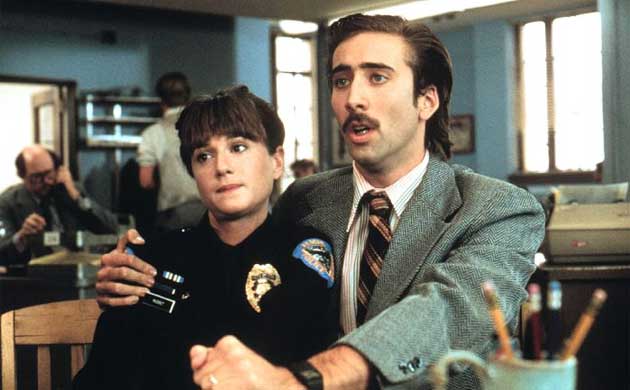
"My name is H. I. McDunnough. Call me Hi." So begins the contemplative narration of our main character, H.I., recidivist convenience store robber. Hi is not a particularly bad man, simply disillusioned. He doesn't even use a loaded gun. Through his criminal actions, he meets Ed, the female police officer who takes his mug shots. It's short for Edwina. Serving his first prison sentence, H.I. considers it tedious but finds an appreciation for the spirit of camaraderie. When the parole board allows him to return to the world he can't help but fall back into crime. Having his mug shots taken once again, Hi learns that Ed's fiance (which she pronounces like "finance") has run off with another girl.

Returning to prison, Hi describes a feeling of "homecoming." He tries earnestly to listen to the advice of his counselor, listens to his cellmate's tales of eating sand, and waits until his parole meeting. Upon being arrested yet again, he slips a ring on Ed's finger as she takes his fingerprints. Looking forward to the new life ahead of him, H.I. finally feels the pain of imprisonment. Following his release, he finds Ed at the station and delivers one of the film's most amusing lines: "I'm walkin' in here on my knees, Ed. A free man proposin'."

The newlyweds move into a trailer home just out of town and H.I. acquires a humble job as a metalworker. As he explains, these are the salad days. It all comes crashing down when Ed discovers she is infertile. The couple attempt to adopt a child, but are rejected because of Hi's criminal record. Ed, heartbroken, quits the force and becomes utterly indolent. H.I., too, begins to lose interest in his work and home life, and feels the temptation of crime once again.


A solution presents itself in the arrival of the "Arizona Quints," born to the wife of Nathan Arizona, a local furniture store mogul. Ed asks, begs and forces H.I. to sneak into the Arizona household one night and kidnap one of the quintuplets, assuring him that they have too many to handle. Bewildered, Hi experiences a Looney Tunes-inspired episode while trying to wrangle up the five babies, Harry, Barry, Larry, Garry, and Nathan Jr. He returns to the car with what he believes is Nathan Junior, and Ed bursts into tears of loving joy as if he was her own. She is ecstatic about the family they have "created," but admits that she is apprehensive concerning the massive amount of responsibility they have taken on. Hi is even more confused by the responsibility he is faced with, but he pushes the feeling deep down and replaces it with merry babbling.

Things start to get complicated when they are visited by Hi's jailbird buddies, Gale and Evelle Snoats. Having just escaped from prison, Gale and Evelle make H.I. convince Ed to let them stay. Under their influence, Hi feels the enticing lure of the freedom he once had. That night he has a nightmarish vision of "The Lone Biker of the Apocalypse," a burly, leather-attired, Terminator-esque killing machine. The next morning, unbeknownst to H.I., the beast of a man arrives at the site of the Snoats' breakout. He later shows up at Nathan Arizona Sr.'s office and identifies himself as a bounty hunter named Leonard Smalls, initially offering to find Nathan Junior but ultimately relaying his intention to re-kidnap him for a higher ransom.


Several days after the Snoats brothers arrive, they are told to stay away from the trailer for a while when the McDunnoughs are visited for lunch by Hi's loudmouthed, senseless supervisor Glen, his shrill wife Dot, and their many (approximately five, possibly more) rambunctious children who set about destroying the trailer while Glen makes fun of Polish people. Having been told that the McDunnough baby was adopted, Dot rattles off -- to an increasingly worried Ed -- a list of the many shots and health precautions and education plans that need to be taken care of with an infant. After lunch, H.I. and Glen go for a walk in the desert and Hi confesses his confusion and frustration, hoping to find an answer from someone more experienced. Glen at first pokes fun at him, but reveals that he has of course felt the strain of responsibility. His solution, however, is an offer of wife-swapping. Offended and enraged, Hi punches him in the face.

That night, H.I. and Junior and a very upset Ed go to buy some diapers at the store, and when Ed looks up to see her husband holding the cashier at gunpoint she loses her temper and drives off. A chase ensues in which Hi is pursued by cops, clerks, and dogs. Eventually, Ed turns around and rescues him after he evades capture in a supermarket. Back at home, after Ed storms into the bedroom with Nathan Junior, Gale and Evelle swoop in and persuade H.I. to join them on a series of bank heists. Believing himself truly no good, that it would be best for Ed and Nathan Junior if he were gone, he writes a heartfelt letter explaining his reasons for leaving.


Gale and Evelle wake H.I. the next morning after Ed leaves to run errands. They are interrupted by a knocking at the door. H.I. steps out to find a furious Glen, wearing a neck brace and keeping a safe distance. Glen explains firstly that Hi has been officially fired, not to Hi's surprise. He then reveals that he and Dot have deduced Nathan Junior's true identity, and if Hi and Ed don't want to be turned into the police they need to hand over the baby in the next few days to fulfill Dot's desire for another child.

Glen drives away, but Gale and Evelle, having overheard that their friend's baby is actually the missing Arizona Quint for whom there is a juicy $25,000 reward, overpower H.I., tie him to a chair, and abscond with Nathan Junior. At first planning to turn in the tot for the money, the Snoatses grow attached to Nathan Junior after they leave him behind at a gas station and speed screaming back to him. They decide to keep him as their own. They take him along to their first bank heist, a "hayseed" bank apparently far from any other establishments, but when they drive off with the money they realize they have forgotten him once again. In their moment of panic, they hit rock bottom when an anti-theft dye canister explodes in the loot sack and nearly runs them off the road.


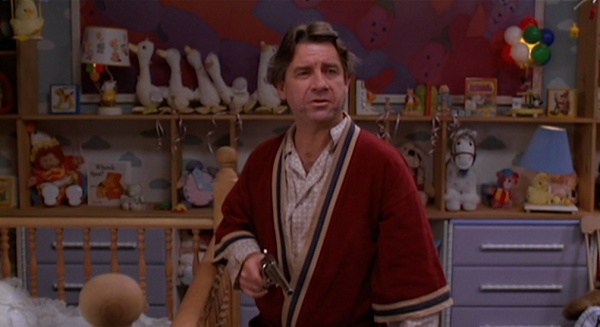
Ed and H.I. arrive at the bank just moments too late. Smalls appears on his motorcycle, packing two shotguns, knives, and several grenades. He scoops up Nathan Junior in his car seat from the middle of the road and blows up the McDunnoughs' car. A brutal and surreal fight ensues in the street. Despite considerable odds against them, Hi and Ed make it out a live with Nathan Junior. Agreeing to return him to the Arizonas, they sneak in through the window that night and place the baby in his crib. Nathan Sr., having heard them enter, confronts them. He is glad to have his son returned, but soon realizes that they had taken him in the first place. He takes pity on the couple, asking only for an explanation. Nathan offers earnest advice, and when Hi and Ed confess their plans to separate, he suggests they sleep on it. They do.


Now, to fully understand this film, one must understand the world in which it takes place. It is set in Arizona alright -- the cinematography even shows the aridity of the atmosphere -- but the characters often seem to be a little too odd to be accurate portrayals of the everymen they are supposed to be. The Coen brothers, two of America's most idiosyncratic filmmakers, have a wonderfully droll gift for dialogue. To a dedicated Coen watcher, a remarkable number of their lines become inside jokes of sorts. The Coens are able to turn almost anything into a timeless one-liner (e.g. "Son, you've got a panty on your head"). Though the characters here speak in a properly southern accent, it is not uncommon to hear certain phrases wiggle their way in that seem to be outside of the normal vocabulary range. Perhaps the Coens are trying to make a statement about stereotyping, or perhaps it is merely a quirk to draw in a certain audience. More likely, in a delightfully backwards sort of way, they are in fact making their film more realistic. Do we not run into bizarre persons on a daily basis? Are there not aspects of our personalities that we don't always accurately represent in public? Is life really as black and white as we want it to be, or is it peculiar?

Upon its release, Raising Arizona was not considered to be much of a big deal. Many critics thought it too frivolous, and even those that did like it only liked it because of its frivolity. It has since earned a name for itself as a "cult comedy," but even this honor does not do it justice. Too many viewers get caught up in the goofy aspects of the film. Yes, there is certainly a silly and strange outer layer, and yes, it is a large part of the film's appeal, but there are poetic undertones than can slip by if you don't pay attention. The question becomes: "How does this film explain the meaning of life?" If H.I. is the part of us that wants to know, the answer can be found in the supporting characters.

There is Edwina, who herself is a very interesting and ambivalent individual, one who experiences moments of great strength and moments of great weakness. In a way, she represents our inbred selfishness, and how it can distort what we view as right. As a cop, she is an upstanding citizen and a strict follower of the law. But her desire for a child gets the better of her, and she breaks the law to get what she wants. She is, as anyone would be, apprehensive about raising a child, but she trusts her husband to be there for support. Once her perception of right and wrong falls back into order, she regains her strength and dedication. In the climactic scene, when she sets out to rescue Nathan Junior, notice she is again wearing her police uniform.

To H.I., Ed represents freedom from imprisonment, but imprisonment from freedom. There is no doubt he loves her, but it seems he had more than one reason for getting married. She provided the support he required to stay straight. Yet, the pressures she then imposes on him, such as her disapproval of his friends, are what push him back into crime. She makes the biggest decisions in their relationship; having a baby, stealing a baby, returning the baby, even their plans to separate, though she claims to still love him, are largely her idea. However, H.I. often holds himself accountable for her choices, the poor ones in particular. The Coens, who are big fans of repeating dialogue, effectively implement some early on in the film. Hi's three parole board meetings end with the board members asking him if he has learned his lesson. He says yes. The board replies, "OK then," and he is free. Later, at his wedding, after Hi says, "I do," the minister's response is, "OK then."


Then there are the bumbling, conniving Snoats brothers: the older, unflappable, more charmingly loquacious Gale, and the younger, more happy-go-lucky Evelle. To H.I., they represent the carefree debauchery he gave up for family life. When things get rough, when the pressure sets in, Hi wants to run away and return to the comfortable life he knows how to handle. It might not be the noble thing to do, but with a life of thievery he doesn't have to feel the fear of ruining a child's life. If he fails as a robber, the only one who suffers is himself, and he can deal with that.

Then there are Glen and Dot, who represent what Hi thinks is coming. He wants to raise his family well, but does it mean he has to be reduced to the point of telling idiotic racist jokes and applauding his kids for writing "fart" on the wall? H.I. is forced to ask himself the same question as the audience, "Are these people successes or failures? Even if they aren't the most reputable individuals, they've raised quite a few kids without totally collapsing." Hi figures if they've gotten that far, they must have some answers, and it couldn't hurt to ask.


Nathan Junior, too, is a fairly thought-provoking character. His life, so early on, is shrouded in lies and deceit, yet he remains an innocent observer, unaware that he is the cause of so much tumult and emotion. H.I., completely unprepared for child-rearing, refers to the baby book that follows Nathan throughout the film as the "instructions." But intimidating Hi is not his only purpose. Nathan Junior represents uncertainty of identity. In the first place, H.I. is not even sure if it is Nathan Junior that he has taken. Neither is Nathan Sr., as a matter of fact. To Gale and Evelle, he is introduced as Junior. When Glen asks what his name is, Hi says, "Ed Junior." When Dot asks what his name is, Ed says, "Hi Junior." When Glen returns to blackmail H.I., he yells defiantly, "I guess we'll be callin' the baby Glen Junior from now on." And when the Snoatses return to him at the gas station, Gale proclaims, "He's our little Gale Junior now."


By far the film's most cryptic character is the mysterious Leonard Smalls, "The Lone Biker of the Apocalypse," the "warthog from Hell." When first seen in H.I.'s dream, the narration identifies him as "the fury that would be as soon as Florence Arizona found her little Nathan gone." Whether or not he is a real person or a manifestation of Florence's grief, he is responsible for the film's most perplexing elements. Notice, for instance, that although he is, as he is described, demonic and evil and the epitome of hellaciousness, Smalls has bright, serene blue eyes. His presence also results in the film's most surreal sequences. The climactic fight scene between him and H.I. presents several curious moments. Earlier in the film, while his mug shots are being taken, we see that H.I. has a tattoo of Woody Woodpecker. During the fight, he finds that Smalls bears the exact same tattoo. Additionally, there are several sequences in the fight that oddly parallel event that occured in the scene where H.I. compares the quintuplets in the Arizona home. Probably the best rationalization of the Smalls character is to call him a manifestation of Hi's guilt, something he's never really felt within, but haunts him after the kidnapping until their final confrontation. The only thing Hi ever actually says to Smalls is, "I'm sorry."


Though he is the most short-tempered and, relatively, the least intriguing (despite having many of the film's funniest lines), the most respectable character in the film is Nathan Arizona Sr. He leads an honest life, he makes his money honorably, and he loves his family. He may seem irritable, but he tries to do right by those he cares about. In the penultimate scene, upon hearing Ed and Hi's troubles, he makes a sincere effort to say the right thing, to help them find a reason to stay together. Perhaps the closest he comes is the moment when he opens up and says, "I sure hate to think of Florence leavin' me. I do love her so."


The film concludes with a dream H.I. has that night, which we see clips of and hear him describe in a befittingly beautifully-delivered narration. In it, he envisions Gale and Evelle returning themselves to prison, Glen in trouble with a Polish-American cop, and Nathan Junior growing up into a happy adolescence. He dreams years into the future, of an elderly couple, seen only from behind, being visited by their children and grandchildren. Maybe they are Hi and Ed. Maybe their roles can be filled by any couple. In the end, H.I. McDunnough doesn't learn what the meaning of life is. No one can really know, we can only search for reasons to live. Sometimes they're hard to find, but who knows, they might not be too far away.

All of us, cop or criminal or furniture salesman, are capable of selfishness, judgment, imprudence, honesty, dishonesty, dedication, insecurity, guilt, and love. Responsibility's a scary thing. But being surrounded by people you love is something well worth living for.